The CIPLE speaking exam is the one part you can't fully practise alone. In one task you talk with another candidate and have to agree on something together; in another you describe a photo the examiner hands you. After the last mock exam update, this was exactly what learners kept asking me about: how do you rehearse a conversation when there is nobody on the other side?
Now you can. CIPLE Ready plays the second candidate, shows you real photos to describe, and the examiner reads every task aloud — so the speaking practice and the speaking part of every mock exam work much more like the real thing.
How the speaking part of the CIPLE works
The speaking test (Produção e Interação Orais) takes about 10–15 minutes. It is usually done in pairs, with two examiners in the room: one talks to you, the other marks. You talk about yourself, do a short role-play, talk about a photo or a topic, and do a task together with the other candidate — for example, planning a weekend or choosing a present for a friend. If you want the details of what the examiners listen for, I wrote a separate guide to the CIPLE speaking section.
The pair task is where most people feel least prepared. It isn't a monologue: you have to listen, react, disagree politely and reach a decision, in real time, with someone you have never met.
New: a second candidate for the pair task
In every pair task — in the speaking practice and in Parte 4 of the mock exams — the app now plays Candidato B. It goes like this:
- The examiner reads the task aloud, as in the exam: “Vocês são amigos. Planeiem juntos o que fazer no próximo fim de semana…”
- You see only your own role card. Candidato B has a different one, so you don't know in advance what they want.
- B starts the conversation, and you answer out loud. B listens to what you said, defends their own preference at first, asks you questions and, after a few turns, helps you reach a compromise.
- The conversation has up to eight of your turns — about three minutes, like the real task — and B wraps it up.
Here is how a pair task starts: the examiner reads the task, and Beatriz, the other candidate, opens the conversation.
Candidato B speaks natural European Portuguese, uses “tu” as candidates do with each other, and keeps to A2 language. Each scenario has its own person with their own voice — Beatriz, Hugo, Inês, Rodrigo and others. If the AI partner isn't available for any reason, a recorded partner carries on the conversation from where it was, so you are never left without someone to talk to.
New: real photos to describe
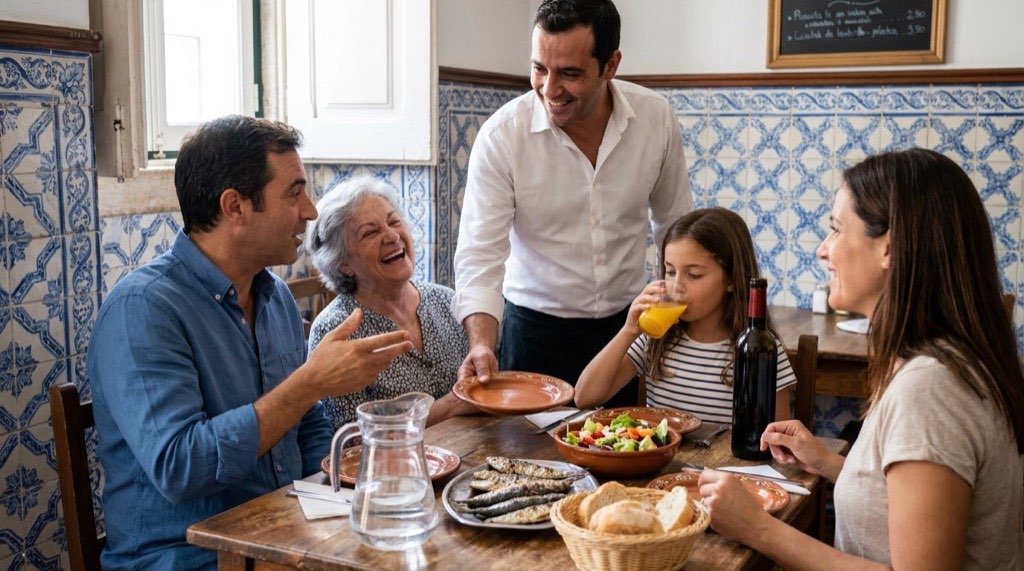
Until now, the photo tasks said “imagine a photo of a market”. Imagining a photo is not the same as describing one under time pressure. So Parte 3 of every mock exam now shows a real photo that matches its topic, with the questions the examiner may ask, and the speaking practice has a new group of photo tasks: a pastelaria in the morning, a train station, a family birthday, a health centre waiting room, a park on Sunday and a supermarket.
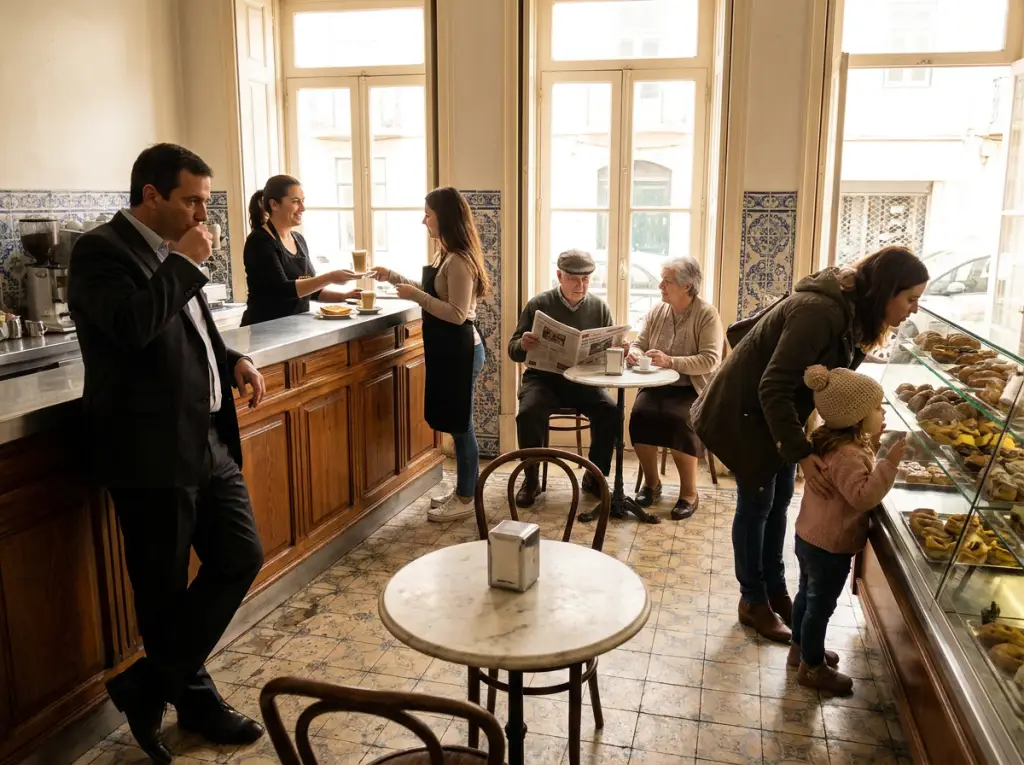

When your answer is marked, the AI knows what is in the photo, so it can tell you whether what you described is actually there — and what you left out.
A simple structure works for any photo: Nesta fotografia vejo… (what and where), À esquerda / À direita / Ao fundo… (who is where), Está a… / Estão a… (what people are doing), Parece que… / Acho que… (a guess), and then your own experience when the examiner asks.
The examiner reads every task aloud
In the exam you hear the tasks, you don't read them. So every speaking task now has “Listen to the examiner”: all the practice tasks and Parts 1–3 of every mock exam, in the same calm examiner's voice as the pair task. Listen first, then answer — it trains exactly the step where nerves usually hit.
Phrases that carry the pair task
You don't need complex grammar to do well in the pair task. You need a handful of phrases to suggest, react and agree:
- O que achas de…? — What do you think about…?
- Eu prefiro… porque… — I prefer… because…
- E se fôssemos a…? — What if we went to…?
- Concordo. / Não concordo muito. — I agree. / I don't really agree.
- Podemos fazer as duas coisas. — We can do both.
- Então, combinado! — So, it's agreed!
Practise them out loud with Candidato B a few times and they come on their own on exam day.
Try it
The first mock exam is free, with its photo task and its pair task, and so are the first three pair tasks in the speaking practice. On the free plan Candidato B speaks with a voice in one conversation a day; with Full Access it's five a day. After that, the recorded partner carries on.
Turn the sound on, allow the microphone, and have your first conversation with the second candidate. It is the closest the platform has ever been to the real speaking exam.
— Yana, founder of CIPLE Ready · Lisbon, October 2026