CIPLE A2 Grammar Topics You Must Know (Full Checklist)

    CIPLE A2 Grammar Topics You Must Know (Full Checklist)

    ·9 min read

    If you're preparing for the CIPLE A2 exam with a citizenship or residency deadline looming, the last thing you need is to wonder whether you've actually covered the right grammar. The stakes are real. Sitting down on exam day and hitting a structure you never practiced is a risk you can avoid.

    I sat the real CIPLE exam myself, so this list is not theoretical — it is the grammar that actually shows up in the tasks, and it maps onto the 20 grammar modules we teach on CIPLE Ready.

    This checklist covers every A2-level Portuguese grammar topic tested on the CIPLE exam. Work through it section by section, note where you feel uncertain, and treat it as a study roadmap. Each topic includes a short explanation and one or two example sentences in European Portuguese with English translations.

    Verb tenses

    Verbs are the backbone of the CIPLE A2 exam. You need to recognize and produce four tenses with confidence.

    Presente (present tense)

    Used for habits, routines, facts, and things happening right now. Regular verbs follow predictable patterns across three conjugation groups: -ar, -er, and -ir. Irregular verbs like ser, estar, ter, ir, and fazer appear constantly and need to be memorized.

    • Eu trabalho em Lisboa. (I work in Lisbon.)
    • Ela faz os trabalhos de casa todos os dias. (She does her homework every day.)

    Pretérito Perfeito (simple past)

    Used for completed actions at a specific point in the past. This tense shows up in reading texts, listening exercises, and writing tasks. Irregular past forms are common and worth drilling.

    • Ontem fui ao supermercado. (Yesterday I went to the supermarket.)
    • Eles comeram no restaurante. (They ate at the restaurant.)

    Pretérito Imperfeito (imperfect past)

    Used for ongoing or habitual past actions, descriptions, and background context. It often appears alongside the pretérito perfeito in the same passage.

    • Quando era criança, morava no Porto. (When I was a child, I lived in Porto.)
    • Chovia muito naquele dia. (It was raining a lot that day.)

    Futuro (future)

    At A2 level, the immediate future using ir + infinitive is the most common form. The simple future tense also appears, but less frequently.

    • Vou visitar a minha família no próximo mês. (I'm going to visit my family next month.)
    • Amanhã viajaremos de comboio. (Tomorrow we will travel by train.)
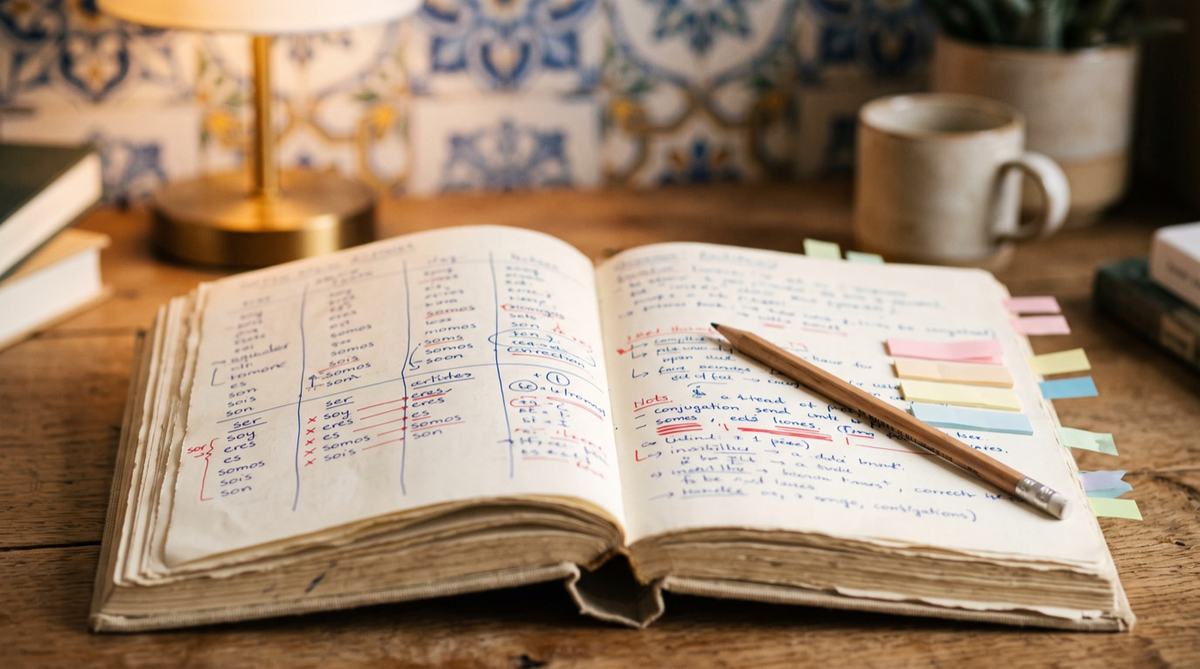
    Grammar notebook with conjugation columns and page markers

    Ser vs. estar

    One of the most tested distinctions at A2 level. Both verbs translate as "to be," but they are not interchangeable.

    • Ser covers permanent or defining characteristics: nationality, profession, origin, identity, and time.
    • Estar covers temporary states, emotions, locations, and conditions.
    • Sou portuguesa, mas estou em Londres esta semana. (I am Portuguese, but I am in London this week.)
    • O café está fechado hoje. (The café is closed today.)
    Mixing these up is one of the most common errors in written and spoken tasks. Practice them in context rather than just memorizing the rule.

    Articles

    Definite articles (o, a, os, as)

    Used before nouns when referring to something specific or already known. Articles must agree in gender and number with the noun they accompany.

    • O livro está na mesa. (The book is on the table.)

    Indefinite articles (um, uma, uns, umas)

    Used when introducing something for the first time or referring to something non-specific.

    • Preciso de uma caneta. (I need a pen.)

    Gender and number agreement

    In Portuguese, adjectives, articles, and pronouns must agree with the noun they describe in both gender (masculine/feminine) and number (singular/plural). This rule applies everywhere, and errors here are noticeable in writing tasks.

    • O menino alto. (The tall boy.) vs. A menina alta. (The tall girl.)
    • Os livros novos. (The new books.) vs. As casas novas. (The new houses.)

    Possessives

    Possessive adjectives and pronouns agree with the thing owned, not the owner. This catches a lot of English speakers off guard.

    OwnerMasculine SingularFeminine Singular
    Imeuminha
    Youteu / seutua / sua
    He/Sheseusua
    Wenossonossa
    • O meu passaporte está na mochila. (My passport is in the backpack.)
    • A nossa casa fica perto do centro. (Our house is near the center.)

    Demonstratives

    Demonstratives point to things by distance: este/esta (this — near you), esse/essa (that — near the listener), and aquele/aquela (that over there — far from both). They agree in gender and number, and the neutral forms isto, isso, aquilo refer to unnamed things or ideas.

    • Este livro é meu, mas esse é teu. (This book is mine, but that one is yours.)
    • Aquela casa é do meu vizinho. (That house over there is my neighbor's.)

    Object pronouns

    Direct object pronouns (me, te, o, a, nos, os, as) replace nouns you have already mentioned. In European Portuguese they usually attach to the end of the verb with a hyphen — one of the details that sets PT-PT apart from Brazilian Portuguese.

    • Compraste o pão? Sim, comprei-o. (Did you buy the bread? Yes, I bought it.)
    • Ela viu-me no mercado. (She saw me at the market.)

    Prepositions

    Small words, big impact. The most important prepositions at A2 level are em, de, a, para, com, por, and entre. Many contract with articles: em + o = no, de + a = da, a + o = ao.

    • Vivo no Porto há dois anos. (I have lived in Porto for two years.)
    • Vou ao médico amanhã. (I am going to the doctor tomorrow.)

    Question words

    Reading comprehension and listening tasks regularly require you to understand and respond to questions. These are worth knowing cold:

    • Quem? (Who?)
    • O quê? / O que…? (What?)
    • Onde? (Where?)
    • Quando? (When?)
    • Como? (How?)
    • Porquê? / Porque é que…? (Why?)
    • Quanto/a? (How much?)
    • Quantos/as? (How many?)

    Example: Onde é que moras? (Where do you live?)

    Imperative for basic requests

    The imperative mood is used for instructions, requests, and directions. At A2 level, you need to recognize and produce basic imperatives, particularly in formal contexts using the você form.

    • Fale mais devagar, por favor. (Please speak more slowly.)
    • Escreva o seu nome aqui. (Write your name here.)

    Reflexive verbs

    Reflexive verbs use pronouns (me, te, se, nos, vos) to show that the subject acts on itself. Common A2 reflexive verbs include chamar-se, levantar-se, sentar-se, and lembrar-se.

    • Chamo-me Ana. (My name is Ana.)
    • Ele levanta-se às sete da manhã. (He gets up at seven in the morning.)

    Comparatives

    Used to compare two things. The structure is straightforward: mais + adjective + do que (more than) or menos + adjective + do que (less than). A few irregular forms like melhor (better) and pior (worse) come up frequently.

    • O comboio é mais rápido do que o autocarro. (The train is faster than the bus.)
    • Este apartamento é menos caro do que o outro. (This apartment is less expensive than the other one.)

    Negation

    Basic negation puts não before the verb. Words like nunca (never), nada (nothing), ninguém (nobody), and nenhum (none) reinforce it — and unlike English, doubling the negative is correct in Portuguese.

    • Não trabalho ao domingo. (I don't work on Sundays.)
    • Não comprei nada no mercado. (I didn't buy anything at the market.)

    Common connectors

    Connectors hold written and spoken responses together. Using them correctly makes a noticeable difference to the quality of your writing tasks.

    ConnectorMeaning
    eand
    masbut
    porquebecause
    entãoso / then
    tambémalso
    no entantohowever
    por issotherefore
    primeiro / depoisfirst / then
    finalmentefinally

    Example: Gosto de morar em Portugal, mas o clima no inverno é difícil. (I like living in Portugal, but the climate in winter is difficult.)

    How to use this checklist

    Go through each section and rate your confidence honestly: comfortable, needs work, or not started. The topics where you hesitate are where your study time should go first.

    A few patterns worth flagging:

    • Ser vs. estar and gender agreement are the most common sources of errors in writing tasks.
    • Pretérito perfeito vs. imperfeito is frequently tested in reading comprehension and listening.
    • Preposition contractions catch many learners off guard in written tasks.
    • Reflexive verb placement differs from both Spanish and English and needs deliberate practice.

    Practice every topic on this list

    Reading a checklist is a start. Building real confidence means working through each topic with exercises that match the actual exam format.

    CIPLE Ready covers all 20 grammar modules across three difficulty levels, with 2000+ exercises built specifically around what the CIPLE A2 exam tests. You can start with the Easy level and work up to Challenge and Advanced tasks as your confidence grows. Every session rotates questions so you're building genuine understanding, not just memorizing answers.

    There's also a free tier so you can try exercises across every section before committing. No installation, no subscription. A one-time payment of €79.50 unlocks the full platform, and a 7-day money-back guarantee applies if it's not the right fit.

    If you have a citizenship deadline coming up, a structured approach matters. Covering every topic on this checklist, in a format that mirrors the real exam, is the most direct way to walk in prepared.

    Start practicing free at cipleready.com.

    Common questions

    What grammar tenses are tested on the CIPLE A2 exam?
    The CIPLE A2 exam tests four main tenses: presente (present), pretérito perfeito (simple past), pretérito imperfeito (imperfect past), and futuro (future), most commonly expressed with ir + infinitive at A2 level.

    Is ser vs. estar really tested at A2 level?
    Yes. The distinction appears in reading comprehension, listening tasks, and writing prompts. It is one of the most common sources of errors for English-speaking learners and is worth dedicated practice time.

    Do I need to know irregular verbs for the CIPLE A2 exam?
    Yes. Common irregular verbs including ser, estar, ter, ir, fazer, and poder appear across all sections of the exam. You don't need to know every irregular verb in Portuguese, but the high-frequency ones are essential.

    How important is gender agreement for the CIPLE writing tasks?
    Very important. Adjective and article agreement is assessed in written responses. Consistent errors in gender or number agreement will affect your score, so it's worth drilling until it feels automatic.

    What is the difference between pretérito perfeito and pretérito imperfeito?
    Pretérito perfeito describes completed actions at a specific point in the past. Pretérito imperfeito describes ongoing, habitual, or background past situations. Both often appear in the same passage, and understanding the contrast matters for reading comprehension and writing tasks.

    Do I need to know the formal imperative for the CIPLE exam?
    At A2 level, yes. Basic imperatives using the você form appear in instructions and requests, particularly in reading and listening texts. You should be able to recognize them and produce simple examples in writing tasks.

    How many grammar topics does CIPLE Ready cover?
    CIPLE Ready covers all 20 grammar modules across three difficulty levels, with 2000+ exercises built around the topics tested on the CIPLE A2 exam. You can start with the free tier to try exercises across every section before deciding whether to access the full platform.

    آخری بار تازہ کاری: July 2026۔ CIPLE Ready کا CAPLE یا یونیورسٹی آف لزبن سے کوئی رسمی تعلق نہیں۔

    准备开始备考了吗?

    免费试用CIPLE Ready:互动练习、AI反馈以及贴近真实考试的题目。

    免费开始 →
    Free PDF

    Preparing for CIPLE? Start with the free guide.

    Before You Start — an honest 11-page guide to the CIPLE exam by our founder, who passed it with Bom. Sent to your inbox.

    Get the free guide